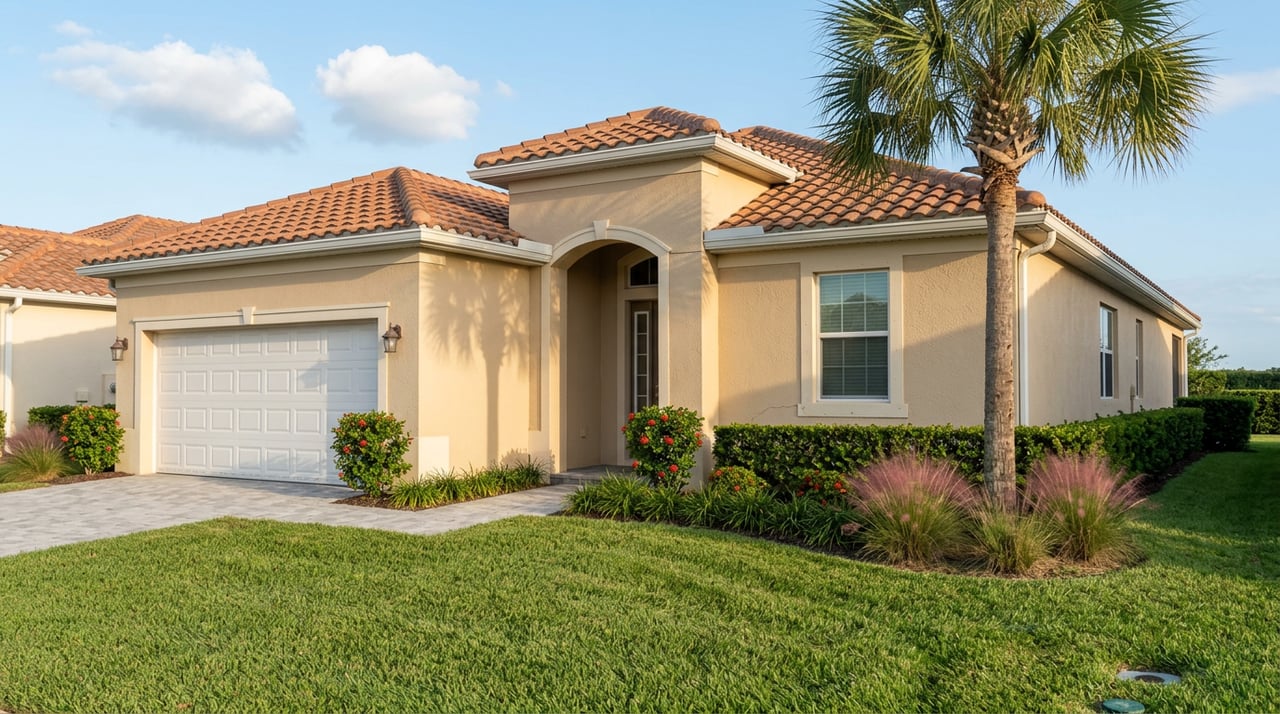
St. Lucie West Isn't the "CDD Trap" Story You've Been Reading About
August 27, 2026
August 27, 2026
If you've spent any time reading Port St. Lucie relocation guides this year, you've probably run into the phrase "CDD Trap." The pitch goes like this: a brand-new home in a master-planned community looks $100,000 cheaper than an older place across the county line, until the tax bill arrives and a Community Development District assessment adds a few hundred dollars a month you didn't budget for. It's a real phenomenon, and it's worth taking seriously if you're shopping in Tradition, Wylder, or Riverland.
It is not, however, a story about St. Lucie West. The neighborhood shares the letters "CDD" with those communities, and that coincidence is doing a lot of unearned work in comparison articles right now. What actually shows up on a St. Lucie West tax bill runs through a different kind of district, funds a different kind of infrastructure, and moves on a different schedule. If you're comparing carrying costs across Port St. Lucie neighborhoods this year, that distinction matters more than the median price.
A Community Development District, in the form most of these warnings describe, is a financing tool. A developer issues tax-exempt bonds to pay for roads, gates, clubhouses and golf courses up front, then passes the debt to homeowners as a special assessment that shows up on the non-ad valorem section of the property tax bill. That debt is typically amortized over 30 years, and it follows the property through every resale until the bonds are paid off.
That's the mechanism behind the sticker shock stories circulating this year: a new build in a community like Tradition or Wylder can carry an annual CDD assessment in the range of $65 to $200 a month, with the bond-repayment portion running alongside a separate operations and maintenance assessment for as long as seven to thirty years. Layer county millage on top, which has historically run among the higher effective rates in Florida even after the City of Port St. Lucie trimmed its own portion to 4.9750 mills for the 2025-26 budget, and it's easy to see how a lower purchase price gets absorbed by a higher monthly carrying cost.
That story is accurate. It's also describing a specific kind of district: one still amortizing a construction bond for amenities the developer built. St. Lucie West doesn't fit that description, because St. Lucie West doesn't have that kind of district running its assessments.
The entity responsible for St. Lucie West's non-ad valorem line item is the St. Lucie West Services District, established in 1990 to cover a 4,600-acre footprint under Florida's Chapter 190 framework. On paper, it's still technically a CDD. In practice, its stated job is water treatment and distribution, wastewater collection and reuse, stormwater management, and reclaimed irrigation. Roads, gates and clubhouse amenities aren't in that mission statement, because those elements of St. Lucie West were built and handed off differently decades ago.
The governance is different too. A newly-formed CDD in a community still under construction is often controlled by the developer's own board until enough homes sell to shift control to residents. St. Lucie West Services District has moved well past that stage. It's overseen by a five-member Board of Supervisors, all of whom are St. Lucie West residents, elected to four-year terms. When the board sets an assessment, it's answering to the people who pay it, not to a builder still selling lots.
Here's how the two structures actually compare:
| Newer amenity-bond CDD (Tradition/Wylder-style) | St. Lucie West Services District | |
|---|---|---|
| What it primarily funds | Roads, clubhouses, gates, golf infrastructure built by the developer | Water, wastewater, stormwater and reclaimed irrigation operations |
| How it's billed | Debt-service assessment plus a separate O&M assessment, both non-ad valorem | Operations-driven assessment billed per Equivalent Residential Unit (ERU) |
| Who sets it | Developer-controlled board in early years, resident-controlled later | Board of five elected St. Lucie West residents |
| How far ahead it's forecast | Fixed by the original bond amortization schedule | Published as a rolling five-year forecast, revisited annually |
This is the part that makes the distinction more than academic. St. Lucie West Services District's fiscal year runs October through September, which means the district is currently finishing fiscal year 2026 and about to set its FY2027 budget. Its own final FY2026 budget documents show a $30 increase in the Maintenance Assessment per ERU for the current year, alongside a 9.0% utility rate increase tied specifically to a water treatment plant redundancy project, not to amenity debt.
Looking ahead, the district's five-year forecast calls for a $60 increase in the per-ERU assessment in FY2027, tapering to roughly $10 a year through 2028, 2029, 2030 and possibly 2031. The board will hold public hearings on that FY2027 budget, along with stormwater maintenance assessments and utility rates, at its September 1, 2026 regular meeting, which puts the next round of numbers about a week out from whenever you're reading this.
Compare that cadence to a bond-financed CDD, where the assessment schedule was locked in years ago at bond issuance and doesn't move based on an annual public hearing. St. Lucie West's number changes because a resident-elected board reviews an operating budget every year, not because a construction loan is amortizing on a fixed schedule.
That's really the whole distinction in one sentence: one system telegraphs small operational adjustments a board can explain in a public meeting, and the other locks in a large fixed payment the day the bonds are sold.
If you're evaluating a specific address, skip the neighborhood-wide narrative and go straight to the parcel.
If you're weighing a move-up purchase or a relocation between St. Lucie West and one of the newer master-planned communities west of I-95, the headline "CDD Trap" framing can push you toward a decision that doesn't match the actual numbers on either address. St. Lucie West's older infrastructure means the community isn't financing a fresh 30-year amenity bond through your tax bill. A newer community's amenities, the ones that make the glossy renderings look so good, are frequently still being paid down by exactly the assessment schedule the warnings describe.
Neither situation is automatically better. A newer district's amenities may be worth the assessment to you. An older district's lower amenity overhead comes with a more established feel and fewer surprises tied to construction financing. What matters is that you're comparing the right mechanism to the right neighborhood, instead of applying a warning about one community's financing structure to a different one that doesn't use it.
Is the St. Lucie West Services District the same as a homeowners association? No. HOAs handle things like architectural standards and shared amenity maintenance and bill separately. SLWSD is a public district responsible for water, wastewater, stormwater and reclaimed irrigation infrastructure, and its assessment appears on the non-ad valorem portion of your county tax bill.
Will my SLWSD assessment keep increasing every year? The district publishes a rolling five-year forecast rather than a fixed schedule. Current projections show a larger increase in FY2027 followed by smaller annual increases through roughly 2031, subject to the board's public budget hearings each year.
Does every home in St. Lucie West pay into this district? Any property within the district's roughly 4,600-acre boundary is billed. If you're evaluating a specific address, the St. Lucie County Tax Collector's records will show whether that parcel's non-ad valorem section includes the SLWSD line.
If you're trying to compare what a specific St. Lucie West address actually costs to carry against a home in a newer Port St. Lucie community, that's the kind of parcel-level digging worth doing before you write an offer, not after. Team Napolitano works these numbers on real addresses across St. Lucie West and the Treasure Coast every week. Request a Free Home Valuation and we'll walk through what your specific carrying costs look like, line by line, before the comparison gets made for you by a headline.
Stay up to date on the latest real estate trends.
More than transactions—we offer experienced leadership, collaborative support, and a commitment to lasting relationships rooted in trust and local expertise.