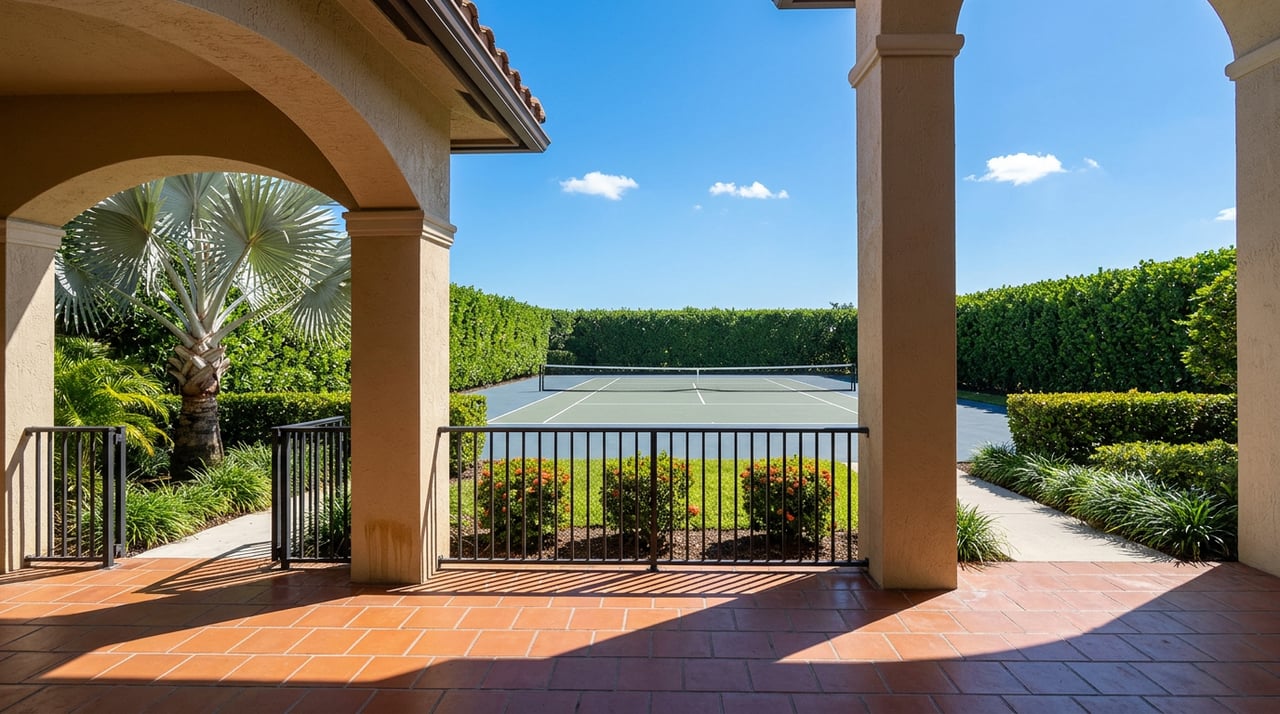
Club Talavera's Pickleball Courts Have a Second Door Most Residents Never Open
September 10, 2026
September 10, 2026
By five o'clock on a September evening, the courts at Club Talavera start to fill in a particular order. The early group tends to be retirees from the Cresswind side, finishing a round before the heat breaks. An hour later, the crowd shifts, and families from Verano's all-ages sections start showing up with paddles that still have price tags half peeled off. Both groups are walking onto the same 27 courts, through the same gate, using the same reservation system on their phones.
Most people who live here know the number. Twenty-seven courts, one of the largest private pickleball complexes in South Florida, enough capacity that the community has hosted the World Pickleball Open twice. What fewer residents seem to know is that the complex actually runs on two separate systems for getting onto a court, and the one most people use is only half of it.
The system most residents default to is CourtReserve, the online booking app tied to the club. You open it, check availability, book a court, and show up at your reserved time. Reservations can be made up to seven days out. Seven of the 27 courts, numbers 1, 4, 5, 6, 14, 15 and 16, are lit for night play, which matters in a state where an August court at 2 p.m. is unplayable and a September court at 8 p.m. is exactly right. Under the club's own rules, a resident can hold one court in the morning and one at night, and any organized group play, leagues, clinics, round robins, is capped at four courts at a time so the rest of the complex stays open for everyone else.
That's the system most people describe when they talk about pickleball at Verano. It's also the reason a newcomer might assume the only way onto a court is to arrange a match in advance with three other people, then book it like a dinner reservation.
The club has a second track built into the same registration system, and it works nothing like a reservation. It's called Challenge Court, and it exists specifically so a resident doesn't need a pre-arranged foursome to play. Courts get registered as "Intermediate/Challenge Court" or "Advanced/Challenge Court," and any resident can walk up, declare their intention to play, and step in once the match in progress ends. No app booking, no four names lined up beforehand, just showing up and calling next.
For a resident who has only ever used the app, this is the part of the system that solves the actual problem people run into during peak season: it's early evening, both your regular partners are busy, and you still want a game. Under the reservation model, that's a dead end. Under Challenge Court, it's the entire point of the format.
| Reservation Court (CourtReserve) | Challenge Court | |
|---|---|---|
| How you get on | Book up to 7 days ahead through the app | Register as Intermediate/Challenge, then walk up and call next when a match ends |
| Who it suits | Groups with a set time and a full foursome already arranged | Anyone who wants a game without lining up players in advance |
| Court limits | One morning slot, one night slot per resident; organized play capped at 4 courts | Governed by whoever's already on court and who's waiting |
| Best time to use it | Planned sessions, lessons, league nights | Early evening walk-ups, solo arrivals, filling a gap in your schedule |
The reason this matters more here than at a typical amenity center comes down to who's actually using the courts. Verano isn't a single audience. It pairs Cresswind, a gated 55+ enclave, with all-ages family sections, and both groups book through the identical system and play on the identical lit courts. There's no separate 55+ pickleball wing and no families-only overflow lot. The retiree playing five mornings a week and the working parent whose kids just picked up paddles are drawing from the same 27 courts, which is exactly why a walk-up option like Challenge Court earns its keep. A rigid reservation-only model would force two very different daily schedules to compete for the same fixed time slots. Challenge Court absorbs the mismatch instead of fighting it.
Pickleball isn't the only thing organized out of Club Talavera, and the surrounding club structure tells you something about how the community actually spends its evenings. Alongside the Pickleball Club, the Social Center runs a Tennis Club, a Mahjong Club, a Book Club, a Fitness Club, an Arts & Crafts Club, and a Veterans Club. None of these exist as one-off events. They're standing groups with their own rhythms, meeting inside the same 40,000-square-foot campus that holds the courts, the card room, the billiards room, and the waterfront lounge. A resident who never picks up a paddle still runs into the pickleball crowd in the same building, at the same hours, because the campus was built as one shared space rather than a set of separate amenities that happen to share a parking lot.
The complex has picked up real outside validation. Verano was named "Best of the Best Tennis & Pickleball" by ideal-LIVING magazine and distinguished as "Outdoor Pickleball Facility of the Year" by the American Sports Builders Association. It has hosted the World Pickleball Open twice. None of that happens on a complex that only functions well during one part of the day. Running a tournament-caliber facility means the courts have to absorb a retiree crowd in the morning, a mixed crowd through the afternoon, and a family crowd after work, without any single group locking up the courts for hours. The two-track system, reservations for planned play and Challenge Court for everyone else, is the mechanism that makes that kind of full-day, full-demographic usage possible. The awards are a byproduct of the system working, not a separate achievement from it.
Fall is when this actually starts to matter for residents day to day. The lit courts get more use once evenings cool off, snowbirds start filtering back in, and the gap between a quiet August court and a packed October one shows up fast. A resident who's only ever booked through the app is going to hit more dead ends as the season fills in. Registering for Challenge Court now, before the complex gets busy, means having a second way onto a court exactly when the reservation slots start running out.
None of this changes anything about deed restrictions, HOA dues, or what any of it means for a home's value. It's simply how the courts at Club Talavera actually work, which is worth knowing whether you've lived on the Cresswind side for a decade or moved into the family section last spring.
If you're weighing a move within PGA Village Verano, curious what a home near Club Talavera is worth this season, or just want a straight answer about how a specific street or floor plan compares to another, Team Napolitano knows this community court by court, not just neighborhood by neighborhood. Reach out anytime for a conversation, no obligation attached.
Stay up to date on the latest real estate trends.

More than transactions—we offer experienced leadership, collaborative support, and a commitment to lasting relationships rooted in trust and local expertise.