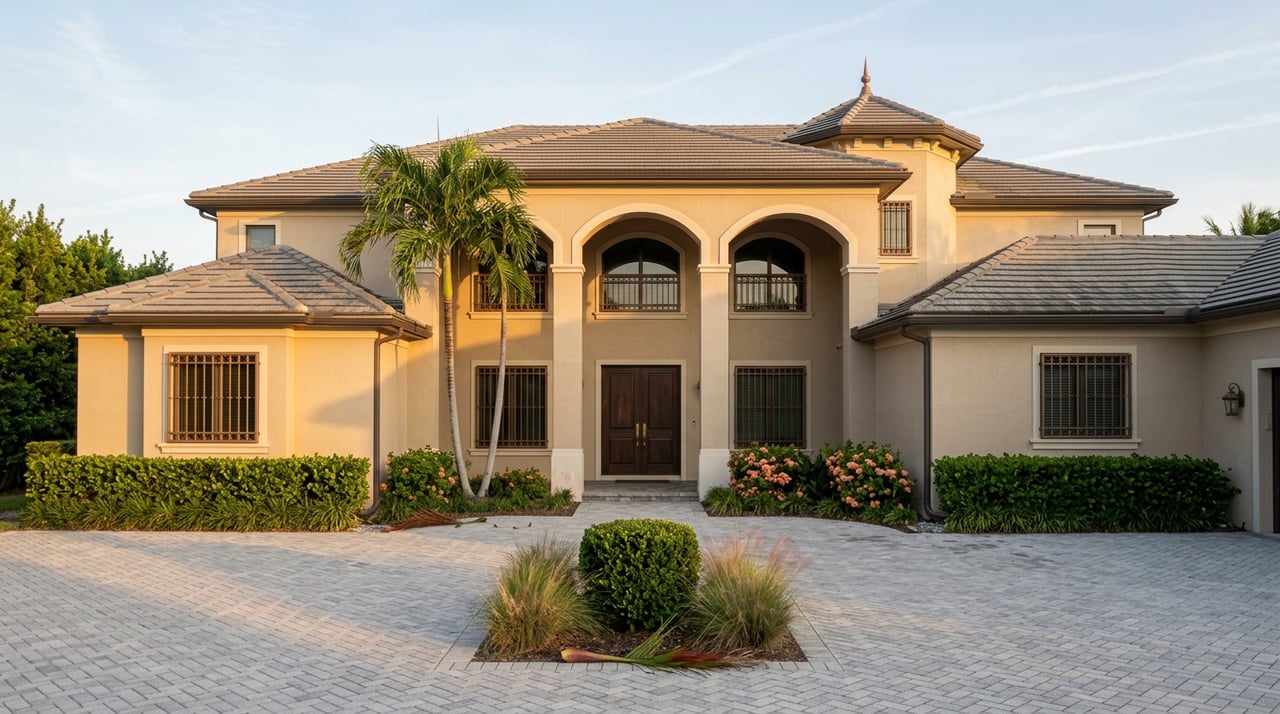
Is PGA Village Golf Membership Optional? What Buyers Need
September 3, 2026
September 3, 2026
Two buyers touring PGA Village this month will walk away with opposite worries, and both of them are wrong for the same reason.
The first buyer doesn't golf. She sees "PGA" in the community name, assumes every homeowner is quietly funding a private course through inflated HOA dues, and crosses the neighborhood off her list before she's toured a single floor plan. The second buyer does golf, and does the opposite math: he sees a modest-looking monthly HOA fee, assumes it already covers club access the way an all-inclusive resort covers the buffet, and doesn't think to ask what joining the actual course costs until he's already under contract.
Neither buyer is reading the fee structure correctly, because PGA Village and its newer sibling community, PGA Village Verano, run on two completely separate ledgers. One belongs to your homeowners association and, in parts of Verano, a Community Development District. The other belongs to PGA Golf Club, a private business that happens to sit next door. They don't share a bank account, and understanding where the line falls between them is the single most useful thing a buyer can know before comparing this neighborhood to anywhere else on the Treasure Coast.
Start with the ledger every buyer already sees on a listing sheet. In PGA Village Verano, monthly HOA dues run roughly $502 to $620 as of mid-2026, and that number is doing more work than it looks like on paper. It covers lawn care, cable and internet, manned gated security, and full access to Club Talavera, the community's amenity campus. That includes a 27,000 square foot social center, a 13,000 square foot fitness facility with EGYM smart-training equipment, an indoor junior Olympic lap pool, a resort-style outdoor pool, and a 27-court pickleball complex that ranks among the largest private pickleball facilities in South Florida, alongside Har-Tru tennis courts, bocce, and a dog park.
None of that requires a golf membership. A resident who never sets foot on a tee box still pays the same HOA line and gets the same key fob to the pool, the pickleball courts, and the fitness studio, because those amenities are baked into the community's carrying cost regardless of what any individual owner does with their weekends.
Some phases of Verano also carry a Community Development District fee, a separate assessment collected through the county property tax bill rather than the HOA statement. It typically funds infrastructure like roads and utility lines rather than clubhouse programming, which is one more reason it's worth asking your agent to pull the specific CDD status for any address you're considering rather than assuming one flat number applies across the whole community.
| Ledger | What it covers | Who pays it |
|---|---|---|
| HOA dues (roughly $502 to $620/month in Verano, mid-2026) | Lawn care, cable/internet, gated security, Club Talavera amenities: pools, fitness center, 27-court pickleball complex, tennis, bocce | Every homeowner, golfer or not |
| CDD fee (varies by phase) | Roads, utilities, infrastructure, billed via county tax bill | Homeowners in assessed phases only |
| PGA Golf Club membership | Private course access, practice facilities, club events | Only owners who choose to join |
The second ledger belongs to PGA Golf Club, which operates as its own private entity with its own membership tiers: Full Golf, Sports, Social, Junior Executive, and Family. Initiation runs in the neighborhood of $25,001 to $50,000 depending on category, with annual dues in the range of $10,001 to $15,000 for full golf access. Those figures move with demand and club policy, so treat them as a planning range and confirm current numbers directly with the membership office before you build a budget around them.
This isn't unique to Verano. In the original PGA Village neighborhoods, membership at PGA Golf Club and the separate Legacy Golf & Tennis Club is likewise optional, not something attached to your deed. You can live inside the gates, use the community pool your HOA already pays for, and never sign a single club document. Or you can join, and the club will bill you on its own schedule for a product it prices independently of what the neighborhood charges to maintain your street and your clubhouse.
That separation is the whole point of this piece. PGA Village didn't build a country club model where the course is bundled into what every resident already pays. It built a neighborhood where the golf business next door sells its own product, on its own terms, to whichever residents want to buy it.
The buyer who assumes she's subsidizing golf she'll never play is protecting herself from a cost that was never going to land on her HOA statement in the first place. The structure already shields non-golfers from underwriting the course. Ruling out PGA Village on that basis means walking away from a pickleball center, a fitness campus, and a security-gated neighborhood for a reason that doesn't actually apply here.
The buyer who assumes his HOA fee already includes club access is making the opposite mistake, and it's the more expensive one to discover late. If golf is the reason you're looking at this neighborhood at all, the real question isn't what your HOA covers. It's what the club's current initiation fee and dues structure looks like the week you're ready to sign, because that number sits entirely outside your closing costs and your monthly carrying costs.
This is also where buyers relocating from other golf communities run into trouble. Some golf-anchored developments require club membership by deed or covenant, tying the cost directly to ownership rather than leaving it optional. A buyer who's shopped one of those communities can carry that assumption into PGA Village and be surprised to learn the rules here run the other direction. It's worth confirming, in writing, whether any specific PGA Village address you're considering carries a transferable or attached membership, since resale listings occasionally include one as a selling point rather than a requirement.
If you want a single rule of thumb before you write an offer: treat the HOA and CDD numbers as your full cost of the neighborhood's lifestyle amenities, and treat the golf club's initiation fee and dues as a completely separate decision you make later, on your own timeline, independent of the purchase itself.
If golf isn't part of your plans, your real monthly cost of ownership in PGA Village Verano is close to the HOA figure itself, since pools, fitness, tennis, and pickleball are already inside that number. Budget for the CDD fee separately if your specific address carries one, and confirm that detail before you assume it does or doesn't apply.
If private club golf is the reason you're moving here, build your budget in two layers. Layer one is your housing carrying cost: mortgage, HOA, and any CDD assessment. Layer two is the club, priced and billed on its own schedule, with initiation and dues that can run into five figures depending on the membership category you choose. Call the membership office before you shop homes, not after, so the number you're planning around reflects current availability rather than a range you found online.
For context on the broader market here, Verano's median sale price sits around $500,000 as of mid-2026, with homes spending roughly 130 days on the market and selling near 97.8 percent of list price. That pace gives buyers room to compare a move-in ready home against a build-to-order lot without feeling rushed, which matters if you're also waiting on a club membership decision that doesn't need to happen on the same timeline as your closing.
Is golf membership required to buy a home in PGA Village or PGA Village Verano? No. Membership at PGA Golf Club, and at the separate Legacy Golf & Tennis Club within the original PGA Village neighborhoods, is optional in both communities. Your HOA dues do not include club access.
Does a golf membership transfer with the house if I buy from a current member? This varies by listing and by the club's current policy. Some resale listings advertise a transferable membership as a feature. Confirm the specific terms with the seller and the membership office before assuming one carries over.
Is the CDD fee the same as my HOA fee? No. The CDD, where it applies, is billed through your county property tax bill and generally funds infrastructure like roads and utilities. Your HOA fee is billed separately and funds landscaping, security, and clubhouse amenities.
Do non-golfers pay anything toward the golf club through their HOA? Based on the fee structure in both communities, no. The HOA and golf club operate as separate financial entities, so residents who never join the club aren't carrying its costs through their monthly dues.
Whether golf is the reason you're looking at PGA Village or a feature you're happy to leave optional, the two-ledger structure is exactly the kind of detail that's easy to miss on a listing sheet and expensive to misjudge in an offer. Team Napolitano works these Port St. Lucie golf communities regularly and can walk you through what a specific address actually carries before you write a contract. If you already own here and want to know what today's market means for your equity, request a free home valuation and get a clear answer.
This article is general information, not legal, tax or financial advice. Consult a qualified professional about your situation.
Stay up to date on the latest real estate trends.
More than transactions—we offer experienced leadership, collaborative support, and a commitment to lasting relationships rooted in trust and local expertise.