
Your Guide to Relocating to PGA Village From Out of State
July 2, 2026
July 2, 2026
Are you thinking about buying in PGA Village from another state? You are not alone, and the process can feel a little more layered than a typical move. The good news is that with the right local guidance, you can plan ahead, avoid common surprises, and make your move to Port St. Lucie much smoother. Let’s dive in.
PGA Village stands out for buyers who want a golf-oriented, amenity-rich lifestyle in Port St. Lucie. The community is adjacent to PGA Golf Club, and the area offers easy access for preview trips, inspections, and move-in planning.
Travel is one of the practical advantages here. Community materials note that PGA Village is about 50 minutes north of Palm Beach International Airport and less than two hours from Orlando and Miami. If you are relocating from out of state, that can make the buying process much more manageable.
One of the biggest things to understand is that PGA Village is not just one neighborhood with one simple set of rules. It is a large master-planned, controlled-access community in Port St. Lucie with more than 2,500 properties and many sub-associations.
That matters because your experience can vary by address. The master association handles roads, signs, common areas, preserves, lakes, wetland areas, cable and internet, the Island Club, access control, safety, and gatehouses, while each sub-association manages its own common areas.
If you are buying from out of state, it is important to confirm the exact subdivision early. Dues, rules, parking standards, guest access, leasing rules, and even management contacts can differ from one neighborhood to another.
Current community information also shows that some sub-associations are managed by different companies, while others are self-managed. That means there is no one-size-fits-all answer for every PGA Village address.
This is another point that trips up buyers. The golf club is separate from the residential community, and PGA Village Verano is a neighboring community with its own amenities and structure.
If you are comparing homes online, make sure you are looking at the right community details for the specific property. A home in one PGA-branded area does not automatically come with the same rules, amenities, or membership options as another.
For many out-of-state buyers, PGA Village is about more than the home itself. It is also about how you will live day to day once you arrive.
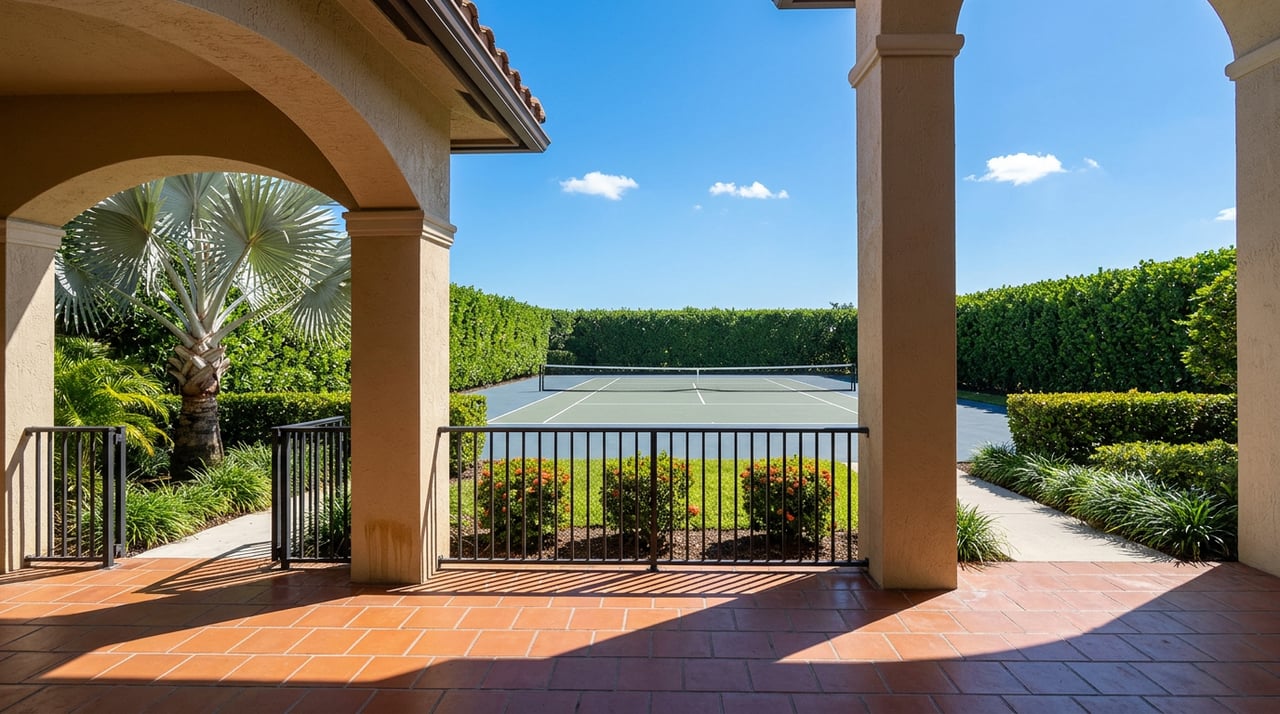
The Island Club serves as the central amenity hub for residents. Current community pages describe a fitness center, heated pool with lap lanes, multi-purpose rooms, four pickleball courts, a tennis court, and a large recreational field.
The resident handbook says an Island Club access card is required for entry, with no more than two cards per household. Buyers need a warranty deed and valid driver’s license to obtain access, while renters need a lease of six months or longer.
If you are relocating, this is one of those small but important post-closing details to handle right away. It helps you get settled faster and start using the amenities without unnecessary delays.
PGA Golf Club is adjacent to the community and offers 54 holes of championship golf across the Wanamaker, Ryder, and Dye courses, plus a six-hole short course. That is a major draw for many buyers moving to the area.
Still, homeownership and golf membership are not the same thing. The club offers its own tee times, instruction, and membership options, so you should verify what is included and what requires separate enrollment.
Gated entry is another key lifestyle feature. Community sources differ slightly on the exact gate count, but they consistently describe staffed gated access and visitor registration requirements.
For an out-of-state buyer, that means every inspection, contractor visit, delivery, and service appointment should be planned with gate access in mind. Visitors need to be pre-registered, so this becomes an important part of your moving checklist.
Buying from another state usually means tighter timelines and more moving pieces. In PGA Village, the community structure adds another layer, so preparation matters.
The best approach is to verify documents and approvals as early as possible. That starts with confirming the exact sub-association and collecting the community information tied to the property you want.
In Florida, the estoppel certificate is a time-sensitive document. State law says the association must issue it within 10 business days after receiving the request, and it is generally effective for 30 days if delivered electronically or 35 days if sent by regular mail.
The estoppel certificate can include amounts owed, transfer or resale fees, open violations, approval requirements, and contact information for other associations tied to the property. For an out-of-state buyer, this is one of the most important items to request early in the transaction.
Florida allows remote online notarization. Under state law, a Florida online notary who is physically located in Florida may notarize documents even when the signer is outside the state, as long as the identity and legal requirements are properly verified through audio-video technology.
That can make a big difference if you cannot travel back for closing. St. Lucie County also supports electronic recording for common documents like deeds and mortgages, which can help remote closings move more efficiently.
When you are moving from out of state, a simple checklist can keep the process organized. Here are some of the most important steps to build into your plan:
Once you close, there are a few practical steps that can make your transition easier. These are especially important when you are arriving from another state and trying to get fully set up quickly.
Start by registering with the community portal, confirming gate access procedures, and reviewing Island Club rules. These steps help you move from owner on paper to active resident in real life.
If the home will be your primary residence, St. Lucie County says homestead exemption may apply to a permanent residence. The filing deadline is March 1 of the tax year, and proof of residency should be dated before January 1.
The county also notes that homestead and other exemptions are not transferable, so if you are moving from another Florida home, you need to reapply for the new property. Applications can be filed online, and portability may allow some Save Our Homes benefit to transfer if you qualify.
Relocating to a community like PGA Village is very doable, but it helps to have someone local who understands the details behind the address. In this community, those details can affect timelines, fees, amenities, gate access, and even who to call for answers.
That is where neighborhood-level knowledge becomes valuable. When you know how to separate the master association from the sub-association, the residential community from the golf club, and the property details from the marketing language, you can make a more confident move.
If you are planning a move to PGA Village from out of state, working with a local team can help you narrow the right section of the community, understand the process, and stay ahead of the administrative steps that come with closing and move-in. When you are ready to start your search or plan your relocation, connect with Annmarie Napolitano.
Stay up to date on the latest real estate trends.
More than transactions—we offer experienced leadership, collaborative support, and a commitment to lasting relationships rooted in trust and local expertise.